Reader-supported: this guide may contain affiliate links. If you buy through them I may earn a commission at no extra cost to you. How this works.
The quick answer
- Tabletop ovens (gas, pellet or small wood-fired) just need a stable, non-combustible surface at a comfortable height. A metal pizza oven table is the easiest option.
- Dome and brick ovens are very heavy and need a concrete foundation, a block base and a reinforced hearth slab.
- Insulate under the oven floor, or the heat drains into the base and the oven struggles to get hot.
- Height: aim for the oven floor around elbow height, roughly 1–1.1m for most people.
- Always follow the oven manufacturer's instructions on clearances and support.
A pizza oven gets extremely hot, and some weigh hundreds of kilograms. Where you put it matters for safety, for comfort, and for how well it cooks. This guide covers both ends of the scale: a simple stand for a tabletop oven, and a DIY block base for a dome oven. If you're also building a BBQ island, the method is very similar. See how to build a BBQ island.
Option 1: A table or stand for a tabletop oven
Most popular pizza ovens are tabletop models, including 12- and 16-inch gas and pellet ovens. They weigh roughly 10–30kg and get hot underneath, so they need:
- A stable, level surface that won't wobble when you're turning pizzas.
- A non-combustible top: stone, concrete, steel or porcelain. Never plastic, glass, or a timber or composite tabletop without a heatproof barrier, unless the manufacturer says it's suitable.
- Space around it for the peel, toppings and plates.
- Clearance from fences, walls, overhanging plants and anything flammable.
A metal pizza oven table is the simplest answer. Look for a stainless or powder-coated steel top, a lower shelf for fuel and tools, and lockable wheels if you want to move it.
Browse pizza oven tables on Amazon
As an Amazon Associate I earn from qualifying purchases.
Browse pizza ovens at The Range
Option 2: A block base for a dome oven
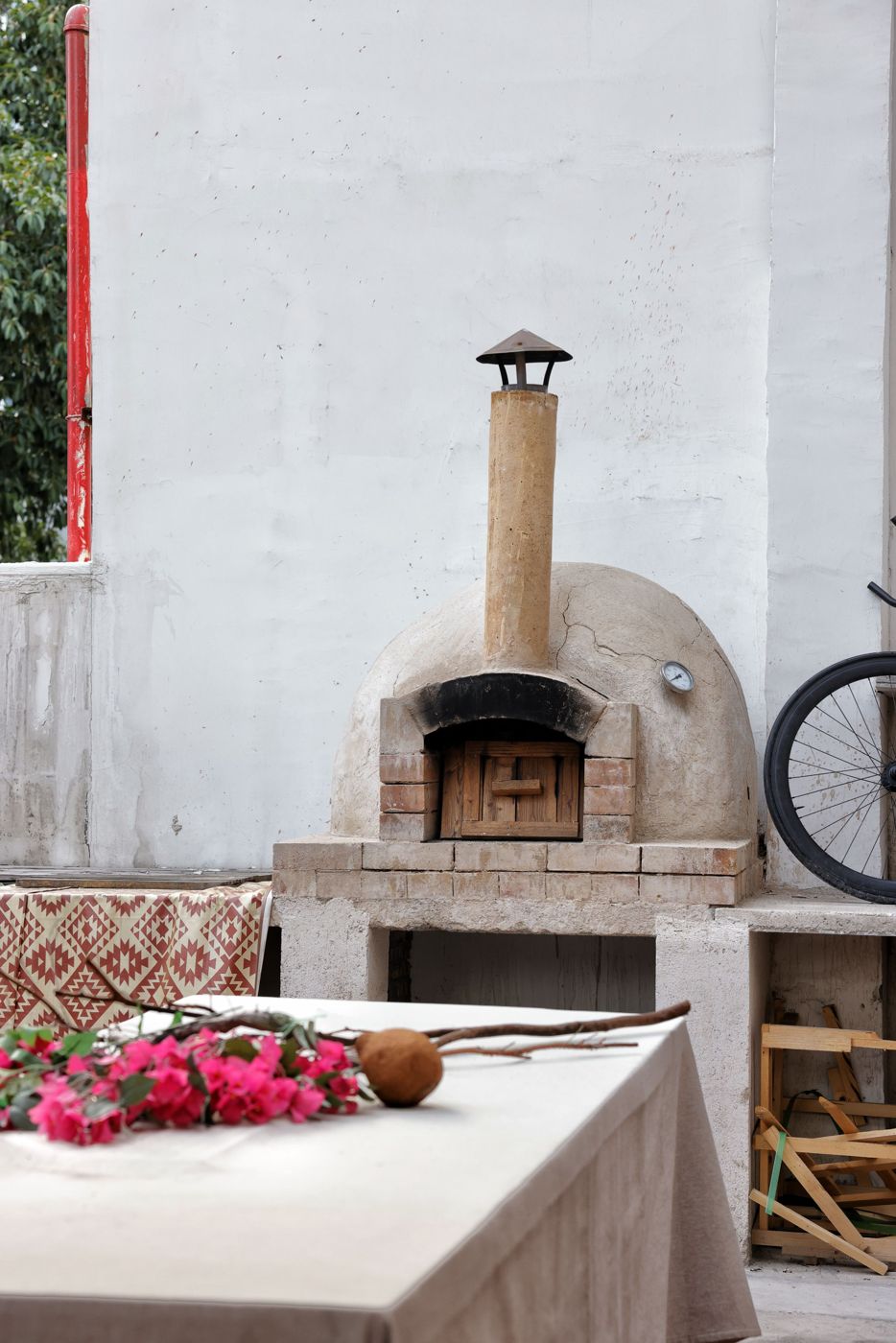
Dome ovens, whether built from a kit or from scratch, are heavy and need a permanent masonry base. A typical build has four layers:
- A concrete foundation slab on compacted hardcore. See how to lay a base.
- Block walls, usually a U-shape with the open side at the front, which gives you a handy log store underneath.
- A reinforced concrete hearth slab across the top of the walls, cast with steel reinforcement, or supported on lintels.
- An insulation layer on the hearth, such as calcium silicate board or insulating vermiculite concrete, with the oven floor (firebricks or the kit's floor tiles) on top.
If you're using a kit, it will specify the size of hearth it needs and the insulation to use. Follow those instructions over any general guide.
Tools and materials for a block base
Tools worth hiring for a block base
- Cement mixerFor the foundation slab, the mortar and the hearth slab.Hire from HSS
- Plate compactorCompacts the hardcore under the foundation slab.Hire from HSS
- Block splitterClean, dust-free cuts for blocks and paving.Hire from HSS
Hire prices vary by branch and hire length.
- Concrete blocks, sand, cement and ballast (or ready-mix)
- Steel reinforcing mesh or bar and timber shuttering for the hearth slab, or concrete lintels
- Insulation board or vermiculite, as specified by your oven
- Render, brick slips or stone to finish
- Spirit level, string line, trowels and PPE (FFP3 mask, goggles, gloves)
Getting the height and layout right

- Oven floor at about elbow height makes launching and turning comfortable. For most adults that's roughly 1–1.1m.
- Allow landing space of at least 40–60cm on one or both sides for the peel, toppings and finished pizzas.
- Think about the chimney. Keep it clear of trees, roofs and gazebos, and away from neighbours' windows.
- Plan shelter if you want to cook in the rain. See pergola vs gazebo vs awning.
Common mistakes
- Building on paving that isn't sound. A heavy oven will crack slabs that aren't on a proper sub-base.
- Skipping the insulation under a dome oven's floor.
- Using timber close to the oven or under the hearth.
- Making the base too low, which means bending over every time you turn a pizza.
- Firing a new dome oven too hard, too soon. Most kits need several small curing fires first to dry out the mortar and render.
Frequently asked questions
Can I put a pizza oven on a wooden table?
Only if the manufacturer says it's suitable, and ideally with a heatproof board or paver underneath. A stone, concrete or steel surface is much safer.
How high should a pizza oven base be?
Aim for the oven floor to sit at roughly elbow height, usually around 1–1.1m for most adults.
Does a pizza oven need an insulated base?
Dome and brick ovens do. Insulation under the floor keeps the heat in the oven rather than draining into the concrete. Tabletop ovens are insulated already.
Can I put a pizza oven on decking?
A light tabletop oven on a proper stand can work on decking with a heatproof mat, if the manufacturer allows it. Heavy dome ovens need a concrete base, not a deck.

Home cook, keen DIYer and long-time website builder, writing practical outdoor cooking guides for UK gardens. More about me.